Air-O-Latorformulated by Air-O-Lator Corporation
InterMix Direct Drive Submersible Mixer
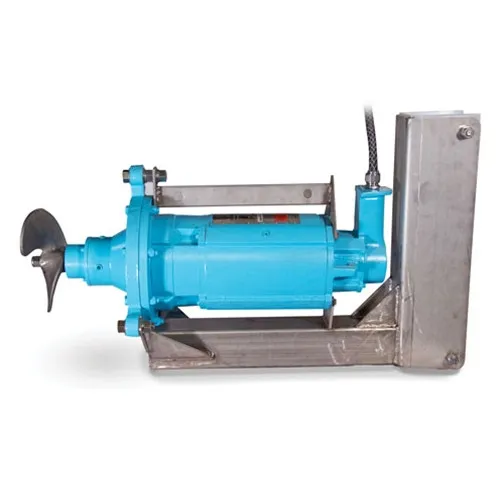
Air-O-Lator InterMix direct-drive submersible mixer, 3 to 7.5 HP. A 10 or 12 inch propeller at about 1,740 RPM for high velocity in a compact basin.
What it is
The InterMix Direct Drive couples a submersible motor straight to a 10 or 12 inch propeller turning near 1,740 RPM. That produces a fast, tight, high-velocity jet suited to wet wells, lift stations, compact basins and chemical mixing, rather than the high-volume turnover a gear-reduced mixer gives a large cell. Available 3, 5 and 7.5 HP.
Buy this when you are seeing
- Solids settling in a wet well or lift station
- Grease and scum building on a small basin
- Polymer or chemical that needs fast local dispersion
- A compact tank where a large slow propeller has nowhere to work
- Short-circuiting through an equalisation basin
How it works
The motor shaft drives the propeller directly, with no reduction. A 10 inch propeller on the 3 and 5 HP units and a 12 inch propeller on the 7.5 HP unit turn at about 1,740 RPM, and the result is a narrow, fast, high-energy jet.
That jet is the right tool for a specific set of jobs. In a small basin, a wet well or a lift station wet pit, velocity near the discharge is what keeps solids off the floor and grease off the surface. In chemical or polymer mixing, fast local shear is exactly what you want and a slow large-volume column is not.
It is the wrong tool for a lagoon cell, and the datasheet says so plainly. At 5 HP the direct-drive unit moves 4,000 GPM; the gear-reduced unit on the same motor moves 13,000 GPM. If your duty is turning over a large basin, the extra cost of the gearbox is not a premium, it is the product.
Propeller bearings sit separately in the fairwater rather than on the motor shaft. On a machine built for raw, screened wastewater that is what takes the side loading off the motor and buys service life.
The motor is a Baldor three-phase continuous duty unit with Class F insulation, UL listed for Class 1, Group D, Division 1 explosion-proof service, with a 30 foot power cord, so a classified wet well is within scope.
Check these before you buy
These decide whether this product can work at all. If one fails, fix that first, because the money spent here will not survive it.
- Confirm the duty is velocity, not volumeThis is the whole decision. If you need to turn over a large cell, the direct-drive unit will disappoint you no matter which horsepower you buy, and the gear-reduced family is the answer.
- Confirm screening upstreamBuilt for raw, screened wastewater. A small fast propeller is more vulnerable to ragging than a large slow one, so unscreened rag load is a real service-life problem here.
- Source the 4 inch square tube mast locallyThe 304 stainless mount ships with the unit; the mast does not. This is the most common gap between a quoted price and an installed system.
- Confirm three-phase power230V or 460V three-phase only. There is no single-phase option in this family.
- Check hoist access above the mastThe guide rail exists so the mixer is pulled from the deck without entering the tank, which only works if there is headroom and access to lift it out.
Is this the right fit
Good fit for
- Wet wells, lift stations and pump station wet pits
- Compact basins where a 26 or 30 inch propeller has nowhere to work
- Chemical and polymer mixing needing fast local shear
- Equalisation basins that short-circuit
- Classified areas needing the Class 1, Group D, Division 1 listing
Not the answer for
- Large lagoon cells, digesters and sludge holding tanks, which need the gear-reduced unit
- Any duty specified as a whole-basin turnover time
- Sites with only single-phase power
- Adding dissolved oxygen, which is an aerator's job and not a mixer's
Dosing and application
- Sizing basis
- Basin volume and the velocity or turnover the duty requires. For a compact basin the useful check is whether the jet reaches the far wall with energy left in it.
- Mounting
- 304 stainless motor support and mount fitting a 4 inch square tube mast, sourced locally. Allows raising, lowering and removing the mixer without entering the tank.
- Motor
- Baldor three-phase continuous duty, Class F insulation, UL listed for Class 1, Group D, Division 1 explosion-proof, with a 30 ft power cord.
- Voltage
- 230V or 460V, three-phase. Confirmed at quote.
- Operating depth
- Rated to 30 feet, in open or closed tank configurations.
- Propeller bearings
- Housed separately in the fairwater, so propeller side loads are not carried by the motor.
- Sold separately
- Guide-rail mast, motor starter protector and submersible power cable. We quote them with the unit.
- Construction
- Manufactured in the United States, designed for a 15 to 20 year service life.
What to expect, and when
- Hour oneMixing starts on energisation. In a compact basin the effect on the surface is usually visible immediately, which is not true of a large cell.
- First weekWatch the floor and the corners. Direct drive is bought to stop deposition in a specific place, so the check is whether that place has stopped depositing.
- First monthIf a corner still accumulates, adjust aim before adding horsepower. A high-velocity jet is directional, and where it is pointed matters more than how big it is.
- First yearPull the unit on the guide rail for inspection at the manufacturer's interval, and check the propeller for ragging while it is on the deck.
How you prove it worked
For a wet well or lift station, the honest measure is how often you are calling someone out to clear a deposit or a grease mat, compared with the twelve months before the mixer went in. For an equalisation or chemical basin, sample at the outlet and confirm the concentration you are dosing for is the concentration leaving, because short-circuiting is exactly what this unit is bought to end.
The direct-drive InterMix is the cheaper mixer, and that is the least interesting thing about it. What matters is that it does a different job from its gear-reduced sibling, and buying the wrong one is a five-figure mistake that a datasheet comparison would have prevented.
No gearbox. The motor shaft turns the propeller at about 1,740 RPM, a 10 inch propeller on the 3 and 5 HP units and a 12 inch on the 7.5 HP, and what comes out is a narrow high-velocity jet.
Where a fast jet is the right answer
In a wet well, a lift station pit or a compact equalisation basin, the failure you are fighting is local: solids settling on the floor, grease matting on the surface, flow short-circuiting from inlet to outlet without ever mixing. All three respond to velocity in the immediate area, and all three are what this unit is designed for.
Chemical and polymer mixing is the same story. Fast local shear disperses a dose; a slow large-volume column does not, and it will happily carry an unmixed slug straight through.
Where it is the wrong answer
A large lagoon cell. At 5 HP this unit moves 4,000 GPM. The gear-reduced unit, on the same motor and in the same frame, moves 13,000 GPM by turning a 26 inch propeller at 300 RPM instead of a 10 inch one at 1,735. If your duty is expressed as a turnover time for a whole basin, that difference decides the purchase and the gearbox is not an upsell.
We would rather lose the cheaper sale than sell you a mixer that cannot turn your cell over. If you are not sure which side of that line you are on, send us the working volume and we will do the arithmetic.
The parts that carry the service life
Propeller bearings are housed in the fairwater, separate from the motor, so the side loads a propeller generates in solids-laden water are carried by dedicated bearings rather than the motor shaft. The Baldor motor has Class F insulation and a UL listing for Class 1, Group D, Division 1 explosion-proof service, which is what allows a classified wet well.
The 304 stainless mount rides a 4 inch square tube mast, so the mixer is raised, lowered and removed from the deck. In a confined-space wet well, never having to send someone down to retrieve a mixer is worth more than the mount costs. The mast itself is sourced locally and is not in the unit price, which we say at quote rather than in a footnote.
Specifications
| Type | Submersible mixer, direct drive |
|---|---|
| Horsepower range | 3 to 7.5 HP |
| Pumping rate | 2,800 to 4,200 GPM |
| Propeller RPM | 1,735 to 1,740 |
| Propeller diameter | 10 or 12 in |
| Thrust | 130 to 300 lbs |
| Max operating depth | 30 ft, open or closed tank |
| Propeller bearings | Separate, housed in the fairwater |
| Motor | Baldor three-phase continuous duty, Class F insulation, UL listed Class 1 Group D Division 1 explosion-proof, 30 ft cord |
| Voltage | 230V or 460V three-phase |
| Mounting | 304 stainless mount for a 4 in square tube mast, sourced locally |
| Construction | Made in USA, designed for 15 to 20 year service life |
Works alongside
Common questions
Direct drive or gear reduced?
Velocity or volume. Direct drive spins a 10 or 12 inch propeller near 1,740 RPM for a fast tight jet, which suits wet wells, lift stations, compact basins and chemical mixing. Gear reduced turns a 26 or 30 inch propeller at 300 to 430 RPM for three or four times the pumping rate, which is what turns over a lagoon cell or a digester. Buy on the duty, not on the price difference.
Can I use one in a lagoon cell?
Only if the cell is small enough that 2,800 to 4,200 GPM turns it over in the time your specification allows. For most lagoon cells it will not, and the gear-reduced unit at the same horsepower moves more than three times the water. We would rather tell you that before you buy than after.
Is the mast included?
No. The 304 stainless motor support and mount ship with the mixer; the 4 inch square tube mast is sourced locally. It is the most common surprise in a mixer budget, so we raise it at quote.
Do I have to enter the wet well to service it?
No, and that is the point of the guide-rail mount. The mixer rides the mast and is raised, lowered and pulled from the deck. On a confined-space wet well that is a safety feature as much as a maintenance one.
Can it go in a classified space?
The Baldor motor is UL listed for Class 1, Group D, Division 1 explosion-proof service, which is what makes a classified wet well or covered basin possible. Confirm the classification of your specific space with your electrical inspector before ordering.
Will it raise my dissolved oxygen?
Not meaningfully. A mixer moves water and an aerator transfers oxygen. If the problem you are solving is a DO number, an aerator is the purchase.
Read before you buy
Lagoon Sludge Removal: Costs, Options, and How to Decide
Dredging vs biological sludge reduction for wastewater lagoons: real cost ranges, how to measure your sludge blanket, and a decision framework.
SludgeLagoon Sludge Judging: How to Measure Your Sludge Blanket
The grid method for profiling a wastewater lagoon sludge blanket, the tools it takes, and how to convert probe readings into volume and dry tons.