Midge Fly and Red Worm Control
EPA-registered biological larvicide for midge flies, red worms and bloodworms in wastewater lagoons and treatment plants, dosed by flow or acreage.
Short answer
Midge flies and red worms are controlled biologically with Bacillus thuringiensis larvicide, which breaks the larval stage of the life cycle without harming treatment biology or creating effluent toxicity. Dosing runs twice weekly for four weeks initially, then weekly for maintenance, set by plant flow or lagoon acreage.
What we carry
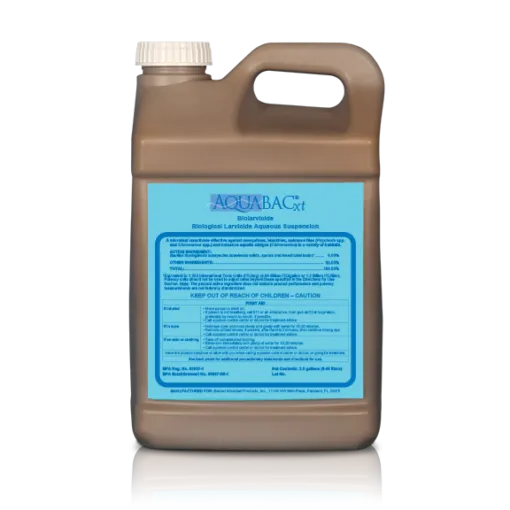
AQUABACxt
For: midge fly swarms drawing complaints from the neighbourhood
US EPA-registered Bacillus thuringiensis larvicide for red worms and midge flies in wastewater lagoons and plants. Safe for treatment biology.
Midge Fly Complete
For: a red worm infestation that resisted larvicide alone
EPA-registered larvicide paired with an enzyme that breaks down red worm cocoons, exposing more larvae to treatment. Complete midge fly control program.
Which one for which problem
| Product | Reach for it when | Form | Applied from | Timeline |
|---|---|---|---|---|
| AQUABACxt | Midge fly swarms drawing complaints from the neighbourhood | Liquid, 5 gallon case | Dosed to the plant or lagoon | Four week initial campaign |
| Midge Fly Complete | A red worm infestation that resisted larvicide alone | Two-part liquid program | Dosed to the plant or lagoon | Four week initial campaign |
Plenty of systems run more than one of these. They are complementary far more often than they are alternatives, and each product page says which it pairs with and why.
Midge flies get treated as a public relations problem, and in a small community they certainly are one. But the larvae, red worms and bloodworms, feed on the biomass doing your treatment, so a heavy infestation is a process problem before anyone complains about a swarm.
Break the life cycle, not the biology
Broad-spectrum insecticides are the wrong tool in a permitted system: they risk effluent toxicity and they hit the biology you depend on. The biological route uses Bacillus thuringiensis, whose endotoxins are specific to target larvae and are US EPA-registered for this use.
| Product | Use |
|---|---|
| AQUABACxt | The larvicide on its own, dosed by plant flow or lagoon acreage |
| Midge Fly Complete | The larvicide paired with an enzyme treatment as a full program |
Dosing is a campaign, not a single application
The pattern that works is an initial period of frequent dosing to break the reproducing population, followed by maintenance dosing to keep it broken. Skipping the maintenance phase because the swarms stopped is the most common way a site finds itself repeating the initial campaign the following season.
Adults already flying are unaffected by a larvicide and have to die off naturally, so judge the treatment by what emerges next rather than by what is in the air today.
Common questions
Why are midge flies a treatment problem and not just a nuisance?
Red worms are midge fly larvae, and they feed on the biomass doing your treatment. Beyond the community complaints that come with a swarm, a heavy infestation consumes mixed liquor solids and disrupts the process. The nuisance is what gets reported; the treatment loss is what costs you.
Will a larvicide harm my treatment biology?
No. Bacillus thuringiensis produces endotoxins specific to the larvae of target insects. It is US EPA-registered, safe for the wider ecosystem, and does not create effluent toxicity problems, which is exactly why it is preferred over broad-spectrum insecticides in a permitted system.
Do the larvae build resistance?
It is difficult for them to, because the product works through six distinct endotoxin compounds rather than a single mode of action. That is the practical advantage over single-mechanism larvicides where resistance develops over successive seasons.
How long before the swarms stop?
The larvicide breaks the life cycle at the larval stage, so adults already flying are unaffected and have to die off naturally. Expect the initial four-week dosing period to show through as fewer emerging adults rather than as an immediate change, then maintenance dosing to hold it.
Read before you buy
How to Get Rid of Cattails and Duckweed in a Wastewater Lagoon
How to remove cattails and duckweed from a wastewater lagoon the permit-safe way: mechanical, herbicide, and aeration options for treatment cells.
SludgeLagoon Sludge Removal: Costs, Options, and How to Decide
Dredging vs biological sludge reduction for wastewater lagoons: real cost ranges, how to measure your sludge blanket, and a decision framework.
AerationWastewater Lagoon Aeration: The Operator's Complete Guide
How lagoon aeration works, surface vs diffused systems, sizing basics, winter operation, and how to choose the right aerator for your cells.