Lagoon and Wastewater Mixers
Submersible mixers for lagoons, digesters, equalization basins and sludge holding tanks, with the direct-drive versus gear-reduced decision explained.
Short answer
A wastewater mixer moves the tank without adding oxygen. Direct-drive units spin a small propeller fast for high velocity in a compact basin; gear-reduced units turn a large propeller slowly for high volume and long throw in a big one. Choose on basin volume and turnover, not on horsepower alone.
What we carry
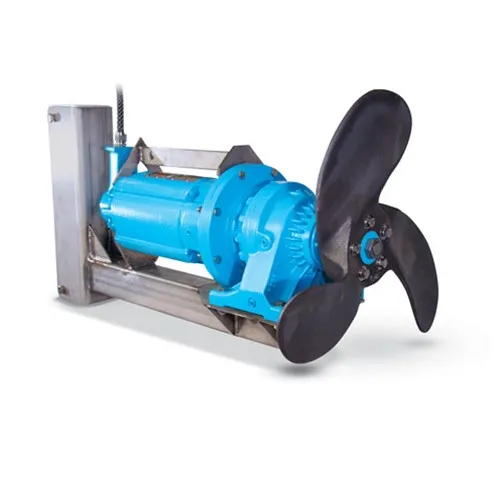
InterMix Gear Reduced Submersible Mixer
For: solids settling out across a large lagoon cell or digester
Air-O-Lator InterMix gear-reduced submersible mixer, 5 to 15 HP. A planetary reducer turns a 26 or 30 inch propeller slowly for 13,000 to 21,000 GPM.
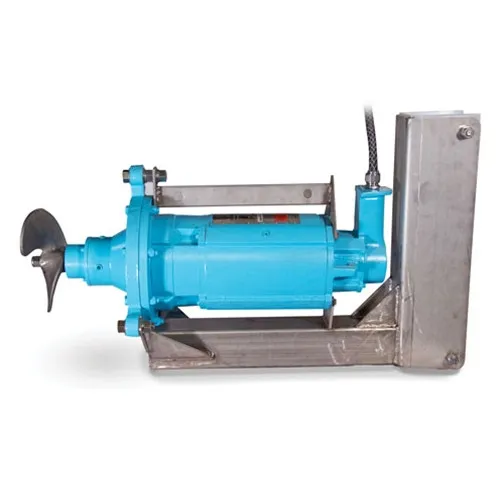
InterMix Direct Drive Submersible Mixer
For: solids settling in a wet well or lift station
Air-O-Lator InterMix direct-drive submersible mixer, 3 to 7.5 HP. A 10 or 12 inch propeller at about 1,740 RPM for high velocity in a compact basin.
Which one for which problem
| Product | Reach for it when | Form | Applied from | Timeline |
|---|---|---|---|---|
| InterMix Gear Reduced Submersible Mixer | Solids settling out across a large lagoon cell or digester | Submersible unit on a guide-rail mast | 304 stainless mount on a 4 in square tube mast, serviced from the deck | Mixing begins the hour it is energised |
| InterMix Direct Drive Submersible Mixer | Solids settling in a wet well or lift station | Submersible unit on a guide-rail mast | 304 stainless mount on a 4 in square tube mast, serviced from the deck | Mixing begins the hour it is energised |
Plenty of systems run more than one of these. They are complementary far more often than they are alternatives, and each product page says which it pairs with and why.
A mixer is bought to solve a specific failure: solids settling where they should not, a sludge blanket that will not stay in suspension, chemical short-circuiting straight to the outfall, or a cell that stratifies and goes anoxic at the bottom while the surface looks fine. None of those are oxygen problems, which is why an aerator is often the wrong purchase for them.
Start with the duty, not the horsepower
| What you are seeing | Points toward |
|---|---|
| Solids settling in a large lagoon cell or digester | Gear reduced, high volume and long throw |
| Sludge blanket that resettles between aeration cycles | Gear reduced |
| Compact basin, wet well or lift station | Direct drive |
| Chemical or polymer needing fast, local dispersion | Direct drive |
| Stratification in a deep cell | Gear reduced, sized on full basin turnover |
| Grit or heavy rag load | Confirm screening upstream before either |
The gearbox is the whole decision
Both InterMix families use the same Baldor submersible motor and the same 304 stainless guide-rail mount. The difference is what happens between the motor and the water.
A direct drive couples the motor straight to a 10 or 12 inch propeller turning near 1,740 RPM. You get a fast, tight, high-velocity jet. In a small basin that is exactly right, and it is the cheaper unit.
A gear-reduced unit puts a planetary reducer in the path so the same motor turns a 26 or 30 inch propeller at 300 to 430 RPM. Slower, much larger, and dramatically higher volume. Compare the two 5 HP models: 4,000 GPM direct drive against 13,000 GPM gear reduced. That is the number that mixes a lagoon cell.
Size on basin turnover
The useful question is how long the mixer takes to turn the basin over once. Take the working volume in gallons, divide by the unit’s pumping rate in GPM, and you have a turnover time in minutes. Most mixing duties are specified as a target turnover rather than a horsepower, and that is the number to bring to a quote.
Mixing intensity requirements vary by application and by state design standard. On a permitted municipal system your engineer and your state standards have the final word, and we are glad to run the arithmetic with you first.
Every unit is quoted
Mixers are freight items with a real installation behind them: mast, power, controls and often a crane or boom to set the first one. The prices shown are our current published prices for the unit itself. Delivered and installed cost depends on your site, so we confirm it in writing before anything ships.
Common questions
What is the difference between a mixer and an aerator?
An aerator is designed to transfer oxygen; a mixer is designed to move water. Some units do both, but the moment you buy a mixer to do an aerator's job you will be disappointed by the dissolved oxygen and the moment you buy an aerator to mix a deep tank you will be disappointed by the dead zones. Decide which duty is controlling before you shop.
Direct drive or gear reduced?
Direct drive spins a 10 to 12 inch propeller at roughly 1,700 RPM and produces high velocity in a small area, which suits compact basins, lift stations and chemical mixing. Gear reduced turns a 26 to 30 inch propeller at 300 to 430 RPM and produces far more pumping volume and a longer throw for the same horsepower, which suits large lagoon cells, digesters and sludge holding tanks.
Why compare pumping rate rather than horsepower?
Because horsepower is an input and pumping rate is the output. A 5 HP gear-reduced InterMix moves 13,000 GPM while a 5 HP direct-drive InterMix moves 4,000 GPM. Same power draw, more than three times the flow, because the gearbox trades speed for a much larger propeller.
Do I have to drain the tank to service one?
Not with the guide-rail mount. Every InterMix ships with a 304 stainless motor support that rides a 4 inch square tube mast, so the mixer is raised, lowered and pulled from the deck. Confirming the mast is in the scope of supply is worth doing at quote, because it is sourced locally rather than shipped with the unit.
Read before you buy
Lagoon Sludge Removal: Costs, Options, and How to Decide
Dredging vs biological sludge reduction for wastewater lagoons: real cost ranges, how to measure your sludge blanket, and a decision framework.
SludgeLagoon Sludge Judging: How to Measure Your Sludge Blanket
The grid method for profiling a wastewater lagoon sludge blanket, the tools it takes, and how to convert probe readings into volume and dry tons.
AerationSurface vs Diffused Aeration for Wastewater Lagoons
A working comparison of floating surface aerators and diffused fine-bubble systems: energy, mixing depth, winter behavior, cost, and where each one fails.