AQUABACxtformulated by AquaFix
AQUABACxt
US EPA-registered Bacillus thuringiensis larvicide for red worms and midge flies in wastewater lagoons and plants. Safe for treatment biology.
What it is
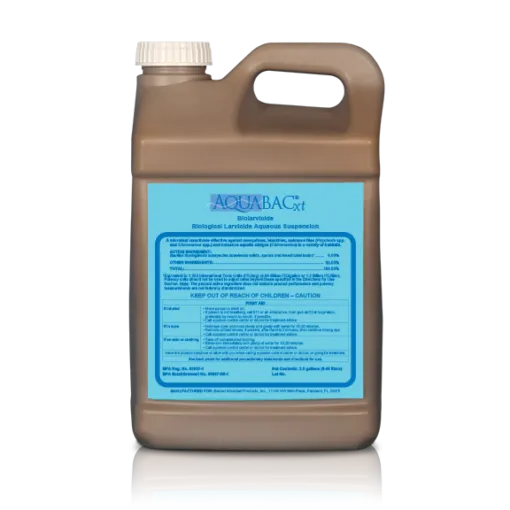
AQUABACxt is a US EPA-registered biological larvicide containing Bacillus thuringiensis, effective against red worms and midge fly larvae but safe for wastewater microbiology. It carries six distinct endotoxin compounds, which makes resistance difficult to develop, and it is dosed by plant flow or lagoon acreage.
Buy this when you are seeing
- Midge fly swarms drawing complaints from the neighbourhood
- Red worms consuming mixed liquor solids
- Stringy or clumpy return activated sludge
- A larvicide the population has developed resistance to
How it works
The active organism is Bacillus thuringiensis, a bacterial species that produces endotoxins lethal to target larvae and harmless to everything else in a treatment system. That specificity is why it is acceptable in a permitted plant where a broad-spectrum insecticide would risk effluent toxicity.
It carries six distinct endotoxin compounds rather than a single mode of action. That is the practical advantage over single-mechanism larvicides: red worms find it difficult to build resistance, so a program does not lose effectiveness across successive seasons the way it can with a simpler product.
It works at the larval stage, breaking the life cycle before adults emerge. Adults already flying are unaffected and have to die off naturally, which is why the treatment is judged by what emerges next rather than by what is in the air on the day you dose.
Check these before you buy
These decide whether this product can work at all. If one fails, fix that first, because the money spent here will not survive it.
- Confirm you have red worms rather than another problemDisappearing mixed liquor solids and stringy or clumpy return sludge are the process symptoms. A microscopic look confirms it before you treat for the wrong thing.
- Plan the full campaign before startingThe initial period is four weeks of frequent dosing followed by maintenance. Starting without budget for the maintenance phase is how a site repeats the initial campaign next season.
- Set expectations about adult fliesA larvicide does nothing to adults already flying. If complaints are the driver, whoever is fielding them needs to know the timeline before treatment starts.
Is this the right fit
Good fit for
- Red worm and midge fly control in permitted systems
- Plants where broad-spectrum insecticides are unacceptable
- Populations that have developed resistance to other larvicides
- Both lagoons and conventional treatment plants
Not the answer for
- Killing adult flies already on the wing
- A single application expecting a permanent result
- Problems that turn out not to be larval at all
Dosing and application
- Plant, initial dose
- Twice a week for 4 weeks. 100,000 GPD: 0.5 gal plus 0.5 gal Lar-V-Zyme. 500,000 GPD: 2.5 gal plus 2.5 gal. 1 MGD: 5 gal plus 5 gal.
- Plant, maintenance dose
- Once per week. 100,000 GPD: 1 pint plus 1 pint Lar-V-Zyme. 1 MGD: 10 pints plus 10 pints.
- Lagoon, initial dose
- Once a week for 4 weeks. 1 acre: 2.5 gal plus 2.5 gal Lar-V-Zyme. 4 acres: 10 gal plus 10 gal.
- Lagoon, maintenance dose
- Once a week for 2 months. 1 acre: 1 gal plus 1 gal Lar-V-Zyme. 4 acres: 4 gal plus 4 gal.
- Pairing
- Dose rates assume pairing with Lar-V-Zyme, which breaks down the cocoons and organic matter shielding the larvae. Midge Fly Complete supplies both together.
What to expect, and when
- Weeks 1 to 4The initial campaign, breaking the reproducing population. Adults already flying are unaffected through this period.
- Week 4 onwardFewer emerging adults as the larval population collapses. This is the first point the treatment is fairly judged.
- Following two monthsMaintenance dosing holds it. Skipping this because the swarms stopped is the most common way a site repeats the campaign next season.
- Process sideMixed liquor solids and return sludge appearance recover as the larvae stop feeding on the biomass.
How you prove it worked
Count emerging adults rather than adults in the air, and watch mixed liquor solids and return sludge appearance on the process side. Both respond to the larval population rather than to what is currently flying.
Midge flies get treated as a public relations problem, and in a small community they certainly are one. But red worms are midge fly larvae, and they feed on the biomass doing your treatment. Disappearing mixed liquor solids and stringy return activated sludge are the process symptoms, and they cost you before anyone complains about a swarm.
The reason to reach for a biological larvicide rather than an insecticide is straightforward in a permitted system: Bacillus thuringiensis endotoxins are specific to target larvae, so there is no effluent toxicity risk and no damage to the treatment biology you depend on.
Plan it as a campaign rather than an application. Four weeks of frequent dosing breaks the reproducing population, then two months of maintenance keeps it broken. The most common failure is stopping at the point the swarms disappear, which is precisely when the remaining population is rebuilding.
Specifications
| Manufacturer | AquaFix |
|---|---|
| Type | Biological larvicide, US EPA-registered |
| Active organism | Bacillus thuringiensis |
| Targets | Red worms, midge fly larvae |
| Modes of action | Six endotoxin compounds |
| Lagoon initial dose | 2.5 gal per acre, weekly for 4 weeks |
| Lagoon maintenance | 1 gal per acre, weekly for 2 months |
| Pack size | 5 gallon case |
Works alongside
Common questions
Will it harm my treatment biology?
No. Bacillus thuringiensis produces endotoxins specific to the larvae of target insects. It is US EPA-registered, safe for the wider ecosystem, and does not create effluent toxicity problems, which is exactly why it is preferred over broad-spectrum insecticides in a permitted system.
Why has my previous larvicide stopped working?
Resistance. Products with a single mode of action lose effectiveness as the population adapts. Six distinct endotoxin compounds make that much harder, which is the main advantage claimed over single-mechanism larvicides.
How much do I need?
For a lagoon, 2.5 gallons per acre weekly for the four-week initial campaign, then 1 gallon per acre weekly for two months of maintenance. A single acre therefore runs 10 gallons initial plus 8 gallons maintenance, and the dose tables assume Lar-V-Zyme alongside at matching volumes.
Why are the flies still here after I treated?
Because a larvicide works on larvae. Adults already flying are unaffected and have to die off naturally. Judge the treatment by how many new adults emerge, not by what is in the air the week you dosed.
Should I buy this or Midge Fly Complete?
The dose tables assume you are using Lar-V-Zyme alongside it, which breaks down the cocoons shielding the larvae. Midge Fly Complete supplies both together and is the simpler purchase unless you already hold Lar-V-Zyme.
Read before you buy
How to Get Rid of Cattails and Duckweed in a Wastewater Lagoon
How to remove cattails and duckweed from a wastewater lagoon the permit-safe way: mechanical, herbicide, and aeration options for treatment cells.
SludgeLagoon Sludge Removal: Costs, Options, and How to Decide
Dredging vs biological sludge reduction for wastewater lagoons: real cost ranges, how to measure your sludge blanket, and a decision framework.
AerationWastewater Lagoon Aeration: The Operator's Complete Guide
How lagoon aeration works, surface vs diffused systems, sizing basics, winter operation, and how to choose the right aerator for your cells.