Air-O-Latorformulated by Air-O-Lator Corporation
Enterprise II Aspirating Aerator
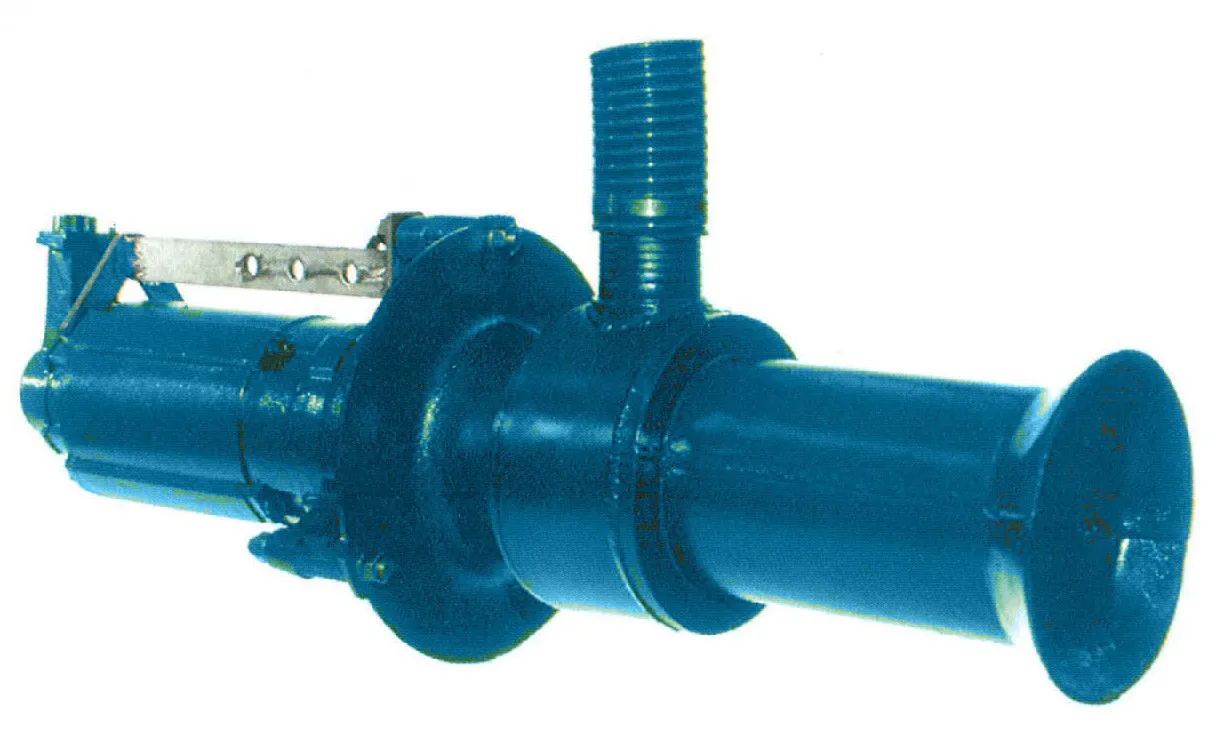
Air-O-Lator Enterprise II aspirating aerator, 3 to 7.5 HP. Draws air down a venturi and discharges below the surface, so there is no spray to freeze.
What it is
The Enterprise II is a submerged aspirating aerator. A propeller drives water through a venturi that pulls atmospheric air down an intake tube, mixes it into the stream and discharges an oxygen-charged emulsion horizontally below the surface. Because nothing is thrown into the air, the manufacturer states no mechanical icing problems. Available 3, 5 and 7.5 HP, mast or float mounted.
Buy this when you are seeing
- Surface aerators icing up or shutting down every winter
- An aerosol plume drifting off the cell toward neighbours
- Ammonia climbing through the cold months
- A cell that needs oxygen and horizontal push at the same time
- Oxidation ditches and basins where a floating unit will not sit still
How it works
The Enterprise II is an axial flow propeller pump inside a shaped volute. The propeller drives a large volume of water past four patented multi-purpose vanes that act as flow straighteners, and the velocity of that stream rises as it passes through.
That accelerating stream is what pulls the air. Moving fast through the nozzle chamber it draws atmospheric air down a four-inch venturi tube into the air plenum, where air and liquid meet in intimate turbulent contact and form an emulsion of oxygen-charged water. The emulsion is then discharged into the main body of the basin.
The discharge is horizontal and below the surface. Nothing is thrown into the air, which is the whole reason the manufacturer states no mechanical icing problems, and it is also why there is no aerosol plume drifting off the cell. On a site with neighbours or a winter that closes down splash aerators, that geometry is the product.
Because the unit is a propeller pump first, it delivers real directional thrust as well as oxygen: 130 pounds at 3 HP up to 300 pounds at 7.5 HP, with induced flow from 3.0 to 6.0 million gallons per hour. In an oxidation ditch or a basin that needs a defined circulation pattern, that thrust is doing as much work as the air.
Air flow can be increased beyond what the venturi draws on its own. The unit is blower adaptable, so where the oxygen demand outruns the natural aspiration the air side can be supplemented rather than the whole unit upsized.
Check these before you buy
These decide whether this product can work at all. If one fails, fix that first, because the money spent here will not survive it.
- Decide the mount before you price the unitMast mount needs a 4 inch square tube mast, a fixed stainless guide rail and a jib boom with a manual marine winch, all of which is site construction. Float mount needs none of that but caps you at about 5 feet of depth. The mount changes the installed cost far more than the horsepower does.
- Confirm three-phase power is availableThe Enterprise II uses a Baldor three-phase continuous duty motor in 230V or 460V. There is no single-phase option in this family.
- Check the basin depth against your mounting choiceThe pontoon float mount is adjustable to a maximum 5 foot depth at various angles. If the duty requires the unit deeper than that, you are on the mast.
- Run a current loading calculationOxygen demand follows pounds of BOD5 applied per day, not surface acres. The thrust and induced flow figures matter too, but they do not substitute for knowing your organic load.
- Confirm the cell is not simply overloadedAspirating aeration is efficient and durable and it still cannot absorb a raw organic overload. If loading is far above design, fix it at the contributor first.
Is this the right fit
Good fit for
- Hard-freeze climates where splash aerators are pulled or lost each winter
- Sites where an aerosol plume is an odor or neighbour problem
- Concrete or steel tank basins with a guide rail already contemplated
- Oxidation ditches and basins that need directional circulation, not just oxygen
- Sites with fluctuating water levels, using the pontoon mount
Not the answer for
- Sites with only single-phase power, since this family is three-phase only
- Float-mounted duty deeper than about 5 feet, which needs the mast instead
- Budgets that cannot absorb the mast, guide rail and boom on top of the unit
- Correcting a raw organic overload, which is a pretreatment problem
Dosing and application
- Sizing basis
- Pounds of BOD5 applied per day, with roughly 1.5 pounds of oxygen per pound of BOD5 as the common planning factor, checked against the mixing and circulation duty the basin needs.
- Air intake
- 4 inch diameter venturi tube, aspirating 40 CFM at 3 HP to 70 CFM at 7.5 HP. Blower adaptable where more air is needed.
- Mast mount
- Optional 304 stainless motor support fitting a 4 inch square tube mast, with a stainless fixed guide rail. The unit rotates to any angle on a dual-purpose upper support and rotational base plate, and a jib boom with a manual marine winch raises and lowers it for variable depth operation.
- Float mount
- Optional pontoon mount on polystyrene foam-filled stainless pontoons, adjustable to a maximum 5 foot depth at various angles. Suited to lagoons, oxidation ditches and sites with fluctuating water levels.
- Voltage
- 230V or 460V, three-phase. Confirmed at quote.
- Motor
- Baldor three-phase continuous duty.
- Sold separately
- Guide-rail mast, motor starter protector and submersible power cable. We quote them alongside the unit.
What to expect, and when
- Hour oneAspiration starts as soon as the propeller is turning. You should hear air drawing at the intake tube.
- First weekLog pre-dawn dissolved oxygen at a fixed station. Also watch the surface: aspirating units produce a boil and a directional current rather than a spray, so a still surface downstream of the discharge means the aiming is wrong.
- First monthCirculation pattern establishes. Adjust the rotation angle on a mast-mounted unit rather than assuming you need a second one.
- First winterThis is where the family earns its price. With no water thrown into the air there is no spray to freeze on the unit, so operation continues where splash aerators are pulled.
How you prove it worked
Log pre-dawn dissolved oxygen at a fixed station and depth, weekly, with a baseline taken before the unit goes in. On a cold-weather install, the meaningful comparison is January to January against your previous aeration, because that is the season the aspirating design is bought for. Pair the DO series with your effluent ammonia results.
Most aeration arguments are surface against diffused. The Enterprise II is neither. It is a submerged propeller pump that makes its own air, and it exists because both of the usual answers have a winter problem or a plume problem.
Water is driven through a shaped volute past four flow-straightening vanes, and it comes out the other side moving fast enough to pull atmospheric air down a four-inch venturi. Air and water meet in the nozzle chamber under turbulent contact, form an emulsion of oxygen-charged liquid, and that emulsion leaves the unit horizontally, below the surface, aimed wherever you have pointed it.
What that geometry buys you
No spray, so no icing. Splash aerators fail in winter because the water they throw into the air comes back down as ice on the unit. The Enterprise II never puts water in the air, and the manufacturer’s specification is explicit: no mechanical icing problems. If you have pulled or lost a surface unit in a January, this is the direct answer to that.
No plume, so no drift. The same fact removes the aerosol that carries odor and mist toward whatever is downwind. On a site with houses on the fence line, that is often what actually decides the purchase.
Real thrust. Because it is a pump before it is an aerator, it produces 130 to 300 pounds of thrust and 3.0 to 6.0 million gallons per hour of induced flow. In an oxidation ditch or any basin that needs a defined circulation pattern, you are buying mixing and oxygen from the same motor.
Where the money actually goes
The unit price is not the installed price on a mast-mounted machine. A mast mount needs a 4 inch square tube mast, a fixed stainless guide rail, a rotational base plate and a jib boom with a manual marine winch. What you get back is the ability to raise, lower, rotate and pull the unit from the deck without draining the basin, which over fifteen years of service calls is worth more than it costs.
The pontoon float mount skips all of that and handles fluctuating water levels, at the cost of a maximum operating depth of about 5 feet. Decide which one you need before you compare prices against anything else, because the two configurations are not the same purchase.
Sizing
Start with pounds of BOD5 applied per day and roughly 1.5 pounds of oxygen per pound of BOD5, then look separately at whether the basin’s circulation requirement sets a higher horsepower than the oxygen requirement does. Our sizing calculator gives a planning range. For a permitted system, your state design standards and a licensed engineer decide, and we will get factory transfer data for your basin conditions to hand them.
Specifications
| Type | Submerged aspirating aerator, axial flow propeller pump |
|---|---|
| Horsepower range | 3 to 7.5 HP |
| Pumping rate | 1,800 to 3,800 GPM |
| Air flow | 40 to 70 CFM aspirated |
| Thrust | 130 to 300 lbs |
| Induced flow | 3.0 to 6.0 MG/HR |
| Air intake | 4 in diameter venturi tube, blower adaptable |
| Propellers | 8 in diameter |
| Discharge | Horizontal, below the surface |
| Icing | No mechanical icing problems, per the manufacturer |
| Weight distribution | 95% of unit weight below the surface |
| Motor | Baldor three-phase continuous duty, 230V or 460V |
| Mounting | 304 stainless mast mount on a 4 in square tube mast, or foam-filled stainless pontoon float mount to 5 ft |
Common questions
What does aspirating actually mean?
It means the unit pulls its own air rather than being fed by a blower. Water accelerating through the nozzle chamber creates enough of a pressure drop to draw atmospheric air down a four-inch venturi tube, and air and water mix into an emulsion before it leaves the discharge. No compressor, no air piping, no blower building.
Why does it not ice up?
Because nothing goes into the air. A splash or spray aerator throws water above the surface where it freezes on the unit and on everything nearby. The Enterprise II discharges horizontally below the surface, so the manufacturer states no mechanical icing problems. That, plus 95 percent of the weight sitting underwater, is why this family is bought for cold climates.
Mast mount or float mount?
Mast mount suits concrete and steel tank basins, holds the unit at a fixed rotation and depth you set with a jib boom and winch, and needs a 4 inch square tube mast and a stainless guide rail installed. Float mount uses foam-filled stainless pontoons, needs no structure, handles fluctuating water levels, and is limited to about 5 feet of depth. The listings here are mast mounted; ask for the pontoon configuration and we will quote it.
How much oxygen does it deliver?
The manufacturer publishes aspirated air flow, 40 to 70 CFM across this family, rather than a pounds-of-oxygen-per-hour rating. Air flow and oxygen transfer are related but not the same thing, and we will not convert one into the other for you with an assumed efficiency. For a permitted design, ask us to get the factory transfer data for your specific basin conditions.
Can I get more air out of a given unit?
Yes. The design is blower adaptable, so additional air can be supplied where the demand outruns natural aspiration. That is usually a cheaper answer than moving up a horsepower class, and it is worth raising at quote if your load is seasonal.
Is single-phase available?
No. This family uses a Baldor three-phase continuous duty motor in 230V or 460V only. If you have single-phase service, look at the 5 or 7.5 HP Aquarian Quantum instead.
Read before you buy
Wastewater Lagoon Aeration: The Operator's Complete Guide
How lagoon aeration works, surface vs diffused systems, sizing basics, winter operation, and how to choose the right aerator for your cells.
AerationWinter Lagoon Operation: Ice, Ammonia, and Keeping Bugs Alive
Why lagoons fail ammonia limits in winter, what to do with aerators before freeze-up, and how to read cold-weather BOD and TSS numbers without fooling yourself.
AerationSurface vs Diffused Aeration for Wastewater Lagoons
A working comparison of floating surface aerators and diffused fine-bubble systems: energy, mixing depth, winter behavior, cost, and where each one fails.
ComplianceWastewater Lagoon Ammonia Removal: Why Lagoons Fail Ammonia Limits
Why lagoons fail ammonia limits, how nitrification actually works in a treatment cell, and the fix ladder from operational changes to capital upgrades.