Air-O-Latorformulated by Air-O-Lator Corporation
Aquarian Quantum Surface Aerator
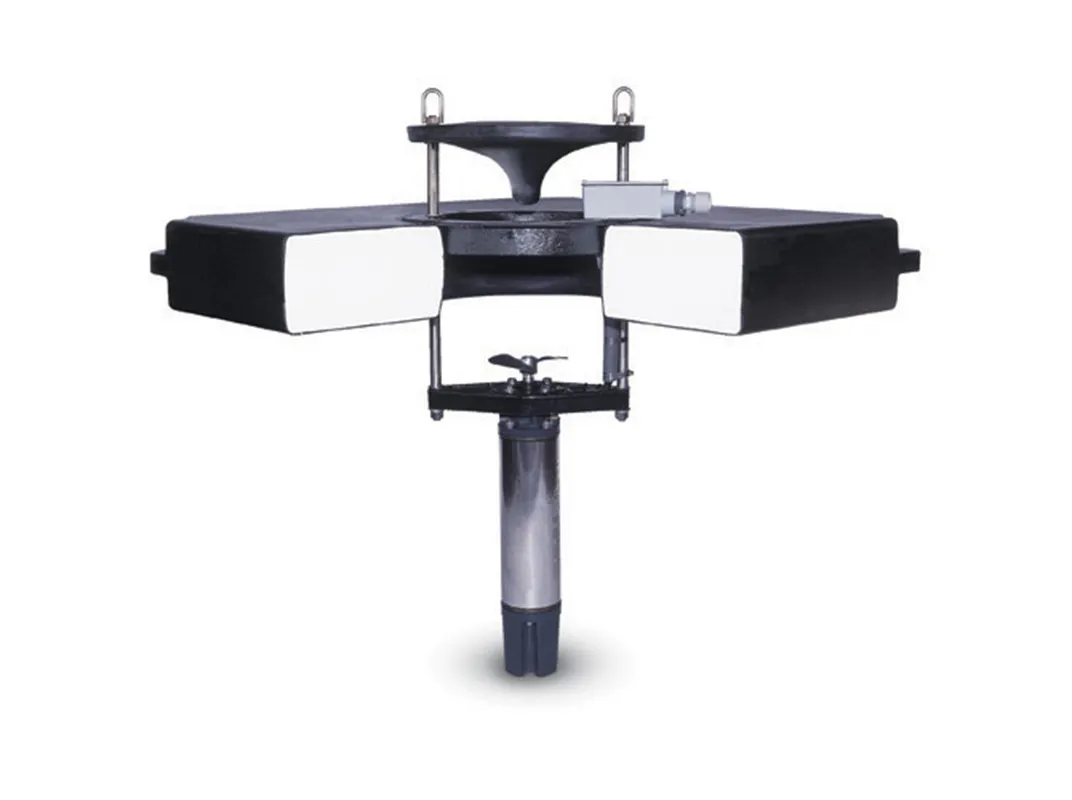
Air-O-Lator Aquarian Quantum floating surface aerator, 5 to 20 HP. Over 95 percent of the unit sits below the surface, so ice and turbulence do not capsize it.
What it is
The Aquarian Quantum is a floating surface aerator that draws water up a draft tube and throws it outward through a diffuser plate in an omnidirectional pattern. It is rated at 3.0 pounds of oxygen per horsepower-hour at standard conditions and carries over 95 percent of its weight below the waterline, which is why it stays upright in ice and chop. Available 5 through 20 HP.
Buy this when you are seeing
- Dissolved oxygen crashing before sunrise
- A cell that needs oxygen this season, not next construction cycle
- Splash aerators that capsize or ice over every winter
- Solids settling out in the upper column of a shallow cell
- Seasonal load the existing system cannot absorb
How it works
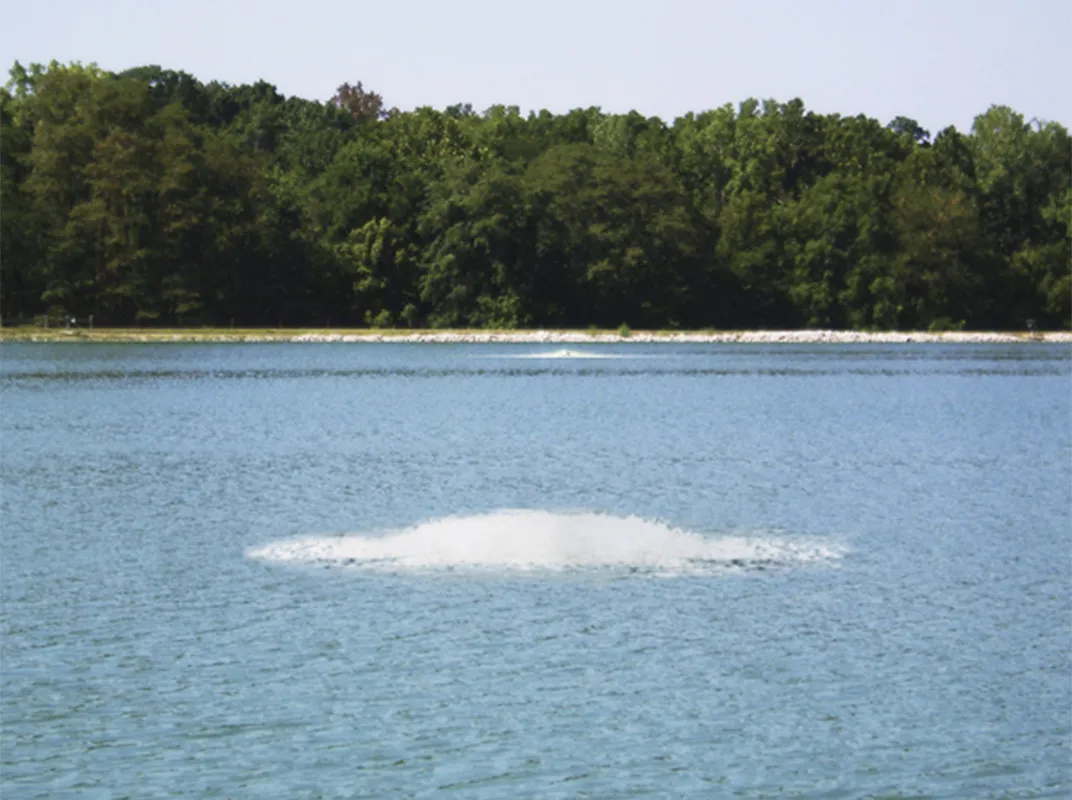
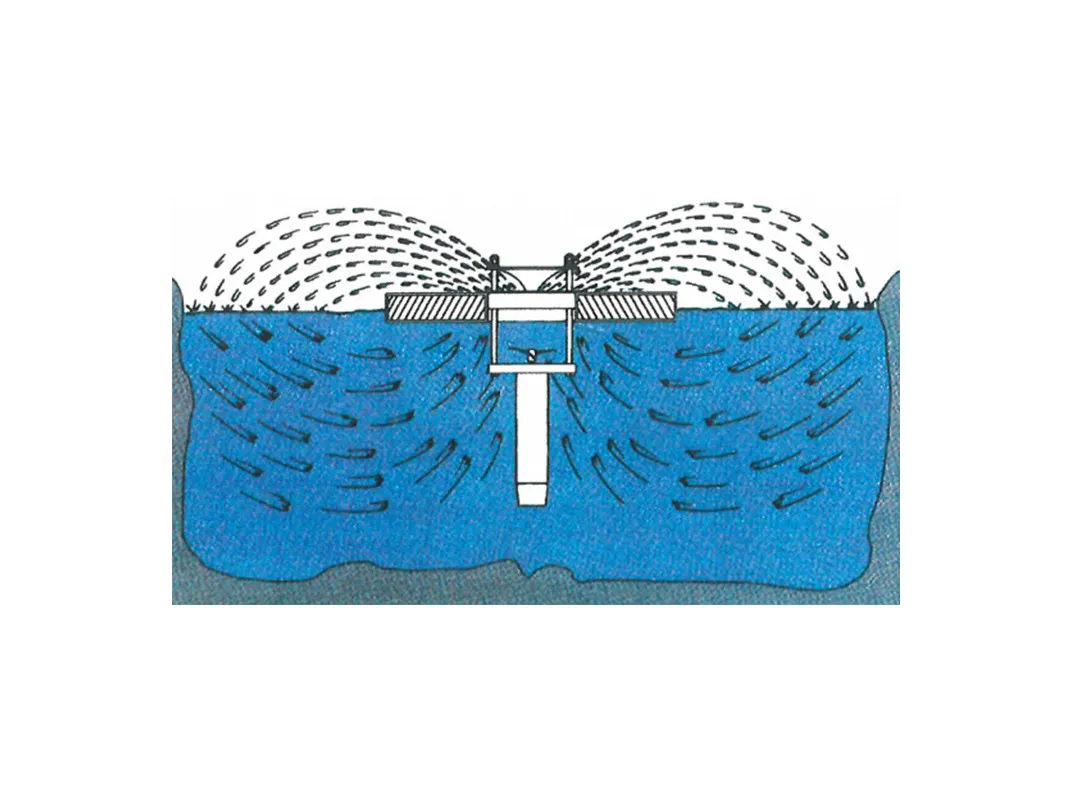
The Quantum is a draft-tube aerator rather than a splash fountain. A submerged motor turns a propeller at the bottom of a central tube, pulling water up from below the float and delivering it to a diffuser plate at the surface. The plate turns that vertical column through ninety degrees and releases it outward in every direction at once.
Two things happen in that turn. The sheet of water leaving the diffuser travels through air at high velocity, which is where the oxygen transfer happens, and the volume being pulled up the draft tube induces a much larger circulation in the cell around it. That induced flow is what carries the oxygenated water away from the unit instead of letting it re-aerate the same patch.
The manufacturer rates the family at 3.0 pounds of oxygen per horsepower-hour. That is a standard oxygen transfer rate, measured in clean water at 20 degrees Celsius with the dissolved oxygen driven to zero. Converted, it is about 1.8 kilograms of oxygen per kilowatt-hour, which sits squarely inside the 1 to 2.5 kg per kWh band published design references give for floating surface aeration.
Field transfer is always lower than standard transfer, because wastewater is not clean water and your cell is not at zero DO. Design engineers apply correction factors for that, and the honest planning rule is to treat the rated number as a ceiling rather than a delivery. Size with the correction applied, not without it.
The stability claim is the other half of the design. Over 95 percent of the unit's weight hangs below the waterline in the motor housing and draft tube, so the float is a collar around a heavy submerged mass rather than a raft carrying a motor on top. That is what keeps it upright when ice forms on the deck or a wind chop builds across a long fetch.
Check these before you buy
These decide whether this product can work at all. If one fails, fix that first, because the money spent here will not survive it.
- Run a current loading calculation before choosing a horsepowerOxygen demand follows pounds of BOD5 applied per day, not surface acres. Two five-acre cells with different loads need very different horsepower, and there is no per-acre shortcut that survives contact with a permit.
- Decide whether oxygen or mixing is the controlling dutyIn partial-mix cells the power needed to keep solids in suspension frequently exceeds the power needed to satisfy oxygen demand. Sizing on oxygen alone produces a system that pencils out and then shows dead zones in the water.
- Confirm your available power service and phase5 and 7.5 HP units are available in 230V single-phase; 10 HP and above are three-phase only. Discovering that after the freight has shipped is an expensive week.
- Check the cell depth at the mooring locationThe unit is rated for operation to 30 feet, but the draft tube still has to hang clear of the sludge blanket. Pulling bottom solids straight up the tube is a maintenance problem you get to keep.
- Confirm the cell is not simply overloadedNo aerator resolves a three-times organic overload on its own. If loading is far above design, the fix is pretreatment at the contributor and the aerator is a bandage on top of it.
Is this the right fit
Good fit for
- Lagoon cells that need oxygen without a construction project
- Sites where a splash-style aerator has iced over or capsized
- Systems whose loading is shifting and may need units relocated
- Supplemental or seasonal oxygen on top of an existing system
- Deeper cells where a shallow-throw surface unit does not reach
Not the answer for
- Basins where the controlling duty is mixing volume rather than oxygen, which is a mixer purchase
- Correcting a raw organic overload, which is a pretreatment problem
- Sites with only 230V single-phase service that need 10 HP or more
- Cells shallow enough that the draft tube would draw from the sludge blanket
Dosing and application
- Sizing basis
- Pounds of BOD5 applied per day, with roughly 1.5 pounds of oxygen per pound of BOD5 as the common planning factor. Run the sizing calculator for a planning range, then confirm with an engineer.
- Rated transfer
- 3.0 lbs O2 per HP-hour at standard conditions. Apply your engineer's correction factors before treating it as delivered oxygen.
- Mounting
- Mooring cable to shore anchors. No shore structure, no piling and no dewatering, which is why installation is measured in hours.
- Voltage
- 5 and 7.5 HP: 230V single-phase, 230V three-phase or 460V three-phase. 10, 15 and 20 HP: 230V or 460V three-phase. Confirmed at quote.
- Operating depth
- Rated to 30 feet. Mooring position should keep the draft tube clear of the sludge blanket.
- Sold separately
- Motor starter protector, submersible power cable and mooring hardware set. We quote them with the unit so nothing arrives incomplete.
- Construction
- Stainless steel, manufactured in the United States.
What to expect, and when
- Hour oneOxygen transfer begins as soon as the unit is energised and the diffuser is throwing water.
- First weekTake dissolved oxygen readings at dawn, not midday. The pre-sunrise minimum is the number that tells you whether the sizing was right.
- First monthInduced circulation shows up as fewer still corners and less surface film. If a corner stays stagnant, the answer is usually mooring position rather than more horsepower.
- First winterThe submerged mass keeps the unit upright in ice, but confirm your operating plan with the manufacturer for your climate before the first hard freeze.
How you prove it worked
Log pre-dawn dissolved oxygen at a fixed station and depth, weekly, starting before the unit is installed so you have a real baseline. That series, alongside your effluent BOD5 and ammonia results, is what tells you whether the aerator did its job. A midday DO reading taken next to a running aerator will look excellent no matter what the rest of the cell is doing.
The Aquarian Quantum sits in a specific gap. A splash-style floating aerator is cheap and fast to install but works only the top of the column and is exposed to icing. A diffused grid is efficient and mixes the whole column but needs a blower building, a bottom install and a construction budget. The Quantum is a floating unit you can moor in an afternoon that still reaches down and moves the deeper water.
The mechanism is a draft tube. A submerged motor turns a propeller below the float, water is drawn up through the tube from depth, and a diffuser plate at the top turns that column outward through the air in every direction. The transfer happens in the sheet leaving the plate; the mixing happens because pulling that volume up the tube induces a much larger circulation through the cell around it.
The number that matters, and what it is not
Air-O-Lator rates the family at 3.0 pounds of oxygen per horsepower-hour. Converted, that is roughly 1.8 kilograms of oxygen per kilowatt-hour, which lands inside the 1 to 2.5 kg per kWh range published design references give for floating surface aeration, so the claim is credible rather than promotional.
It is still a standard rating: clean water, 20 degrees Celsius, dissolved oxygen held at zero. Every one of those conditions is more favourable than your cell. The correct use of the number is as an upper bound in a calculation that then applies correction factors, which is what your engineer does. If someone hands you a horsepower recommendation derived straight from a standard transfer rate with no correction, ask what alpha and beta they used.
Stability is a design choice, not a marketing line
More than 95 percent of the unit’s mass is under the water: the motor housing and draft tube hang below, and the floats are a collar around them rather than a raft carrying a motor on top. A top-heavy splash unit ices up on its exposed deck and eventually goes over. This geometry is why the manufacturer states all-season performance, and it is the single most useful thing to understand about the product if you have lost a surface aerator to a winter before.
Sizing, honestly
Get a current loading calculation first. Oxygen demand tracks pounds of BOD5 applied per day, and design references commonly size oxygen supply at about 1.5 pounds of oxygen per pound of BOD5. Then check the mixing requirement separately, because in a partial-mix cell that is often the duty that actually sets the horsepower. Our sizing calculator will get you a planning range in about a minute; a licensed engineer and your state design standards settle it for a permitted system.
If the numbers say your cell is receiving substantially more organic load than it was designed for, buy the pretreatment first. An aerator sized to cover a three-times overload is an electricity bill with a permit violation still attached.
Specifications
| Type | Floating draft-tube surface aerator |
|---|---|
| Horsepower range | 5 to 20 HP |
| Rated oxygen transfer | 3.0 lbs O2 per HP-hour at standard conditions |
| Pumping rate | 3,400 GPM at 5 HP to 8,300 GPM at 20 HP |
| Max operating depth | 30 ft |
| Weight distribution | Over 95% of the unit below the liquid surface |
| Mounting | Mooring cable, no shore structure required |
| Construction | Stainless steel, made in USA |
| Voltage | 230V single-phase on 5 and 7.5 HP; 230V or 460V three-phase across the range |
Common questions
Which horsepower do I need?
It comes from your loading, not your acreage. Oxygen demand follows pounds of BOD5 applied per day, with roughly 1.5 pounds of oxygen required per pound of BOD5 as the common planning factor. Run the sizing calculator for a planning range, then confirm with an engineer. On a permitted municipal system your state design standards have the final word.
Is 3.0 pounds of oxygen per horsepower-hour what I will actually get?
No, and no manufacturer's rating is. That figure is a standard oxygen transfer rate measured in clean water at 20 degrees Celsius with dissolved oxygen driven to zero, which is the condition that maximises transfer. Real wastewater at real temperature with real dissolved oxygen already present transfers less. Your engineer applies correction factors for that. Treat the rated number as the ceiling and size below it.
How is this different from a splash-style surface aerator?
A splash unit throws water up into the air from at or near the surface. The Quantum pulls water up a draft tube from below and turns it outward through a diffuser plate, so it works the deeper water rather than only the top few inches, and it puts over 95 percent of its own weight underwater. That mass is the reason it does not capsize when ice loads the deck.
Will it run through the winter?
The design is built for it: the weight distribution is specifically intended to stop ice and turbulence capsizing the unit. That is not the same as a blanket guarantee for every climate, so confirm the operating plan with the manufacturer for your site before your first hard freeze. Our winter operation guide covers what changes in a lagoon below about 5 degrees Celsius regardless of which aerator you own.
Do I need three-phase power?
For 10 HP and above, yes. The 5 and 7.5 HP units are also available in 230V single-phase. Tell us your available service when you request the quote and we will confirm the configuration before anything ships.
Why is the pumping rate only listed for some sizes?
Because those are the figures the manufacturer publishes. The family spans 3,400 GPM at 5 HP to 8,300 GPM at 20 HP, and rather than interpolate a number for the sizes in between we ask the factory and give you the real one with your quote.
Read before you buy
Wastewater Lagoon Aeration: The Operator's Complete Guide
How lagoon aeration works, surface vs diffused systems, sizing basics, winter operation, and how to choose the right aerator for your cells.
AerationSurface vs Diffused Aeration for Wastewater Lagoons
A working comparison of floating surface aerators and diffused fine-bubble systems: energy, mixing depth, winter behavior, cost, and where each one fails.
AerationWinter Lagoon Operation: Ice, Ammonia, and Keeping Bugs Alive
Why lagoons fail ammonia limits in winter, what to do with aerators before freeze-up, and how to read cold-weather BOD and TSS numbers without fooling yourself.